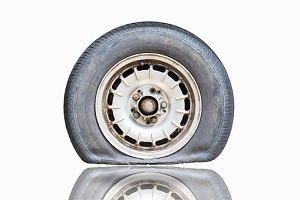
How much do you remember about tire maintenance from your driver’s education class? I bet you don’t remember much. Most courses cover the rules of the road, not how to maintain a vehicle. As a new driver, there are many things to learn. Taking care of your car is one of those things. Let’s start with the one part of your vehicle that touches the road, your tires.
That’s right, your tires are the only part of your vehicle that actually touch the road. That makes them an important safety feature, a factor in fuel economy, and a crucial part of your vehicle’s maintenance. I want to make sure that you can take care of your tires and make them last!
Know how to check your tire pressure! Low tire pressure is the leading cause of tread damage, blowouts, and premature wear. To check your tire pressure all you need is a tire pressure gauge. Check your pressure by removing the cap from your valve stem and inserting the gauge. Most tires have a recommended pressure of 30-35 PSI. If you want to be sure; check your owner’s manual, the sticker on your door jam, or look up the pressure recommendation for your specific tire. If your pressure is not within the recommended range you should add or remove air to reach proper inflation.
You need to know when to have routine maintenance performed. Your tires should be rotated on a regular schedule. Your owner’s manual can give you a suggested maintenance routine or you can ask your local auto mechanic for advice. Tire rotation involves moving your tires and wheels to different positions on your vehicle. This will allow your tire tread to wear down evenly. It also gives your mechanic a chance to double check your tire pressure and take a quick look at your brakes.
Tire maintenance plays a big role in maximizing tire life but no tire will last forever. No matter how well you take care of your tires or how you drive, your tires are affected by time. Natural oils in rubber will evaporate over time causing cracks and damage. Tire maintenance is about keeping tires safe and making them last longer. If your tires make it hazardous to drive, it’s time to get them replaced.
How much do you remember about tire maintenance from your driver’s education class? I bet you don’t remember much. Most courses cover the rules of the road, not how to maintain a vehicle. As a new driver, there are many things to learn. Taking care of your car is one of those things. Let’s start Read More
We are the land of the man (or woman) who has everything. We have electric dog nail trimmers, vacuums that work without your help and phones with more computing power than a fleet of space shuttles. With all this great and not so great stuff, it’s getting harder and harder to give a great gift. Read More
In many parts of the US and Canada, it is common to have two sets of wheels and tires to tackle seasonal differences in driving conditions. You know what to do with them while they are on your car, but what is the proper way to store the ones you put up for the season? Read More
The cornering and rolling forces on each of your tires are different. If you have a front wheel drive car, the power and most of the force is transmitted to the front tires while the rear tires pretty much just follow along like fixed wagon wheels. A rear-wheel drive car or truck sends power to Read More
With all the tires you encounter every day, it is easy to forget their humble beginning and just how far they have come since the early days of automotive development. Follow along as we recap the incredible evolution that has taken us from simple rubber rings to the products we see today. The tire had Read More
Your tires are a big investment, and while it’s easy to just take them for granted, you want them to last through their entire warranty phase (at least). Here are some tips on how to get the most life out of a set of tires: Tire rotations: No vehicle has 50/50 weight distribution from front Read More
So you’re in need of a set of tires for your truck? No problem! The question is, though, what kind of tires are going to be best? First, you’ll need to think about what you use that truck for. Will you regularly be hauling heavy loads or pulling a trailer? Do you expect to keep Read More
Even just a pound or two of underinflation in your tires can be a problem. Why, though? There are several reasons. Fuel economy: If you ever rode a bicycle with a low tire, you know that it feels like you’re riding through wet cement due to the added rolling resistance. The same thing is happening Read More
A blown tire can ruin more than just your day. Tire trouble can cost you money, time, or even damage your vehicle. Sometimes there is no warning your tire is about to blow. Road debris can cause a sudden puncture and there won’t be much you can do, but most tire issues can be prevented Read More
Bigger wheels and tires are a desirable upgrade for not only the off-road extremist but many everyday drivers as well. For example, you can go to Wal-Mart and count several SUVs in the parking lot with 20-inch rims because even “Glamma” wants to look cool. Tires can really make or break your vehicle in relevance Read More